
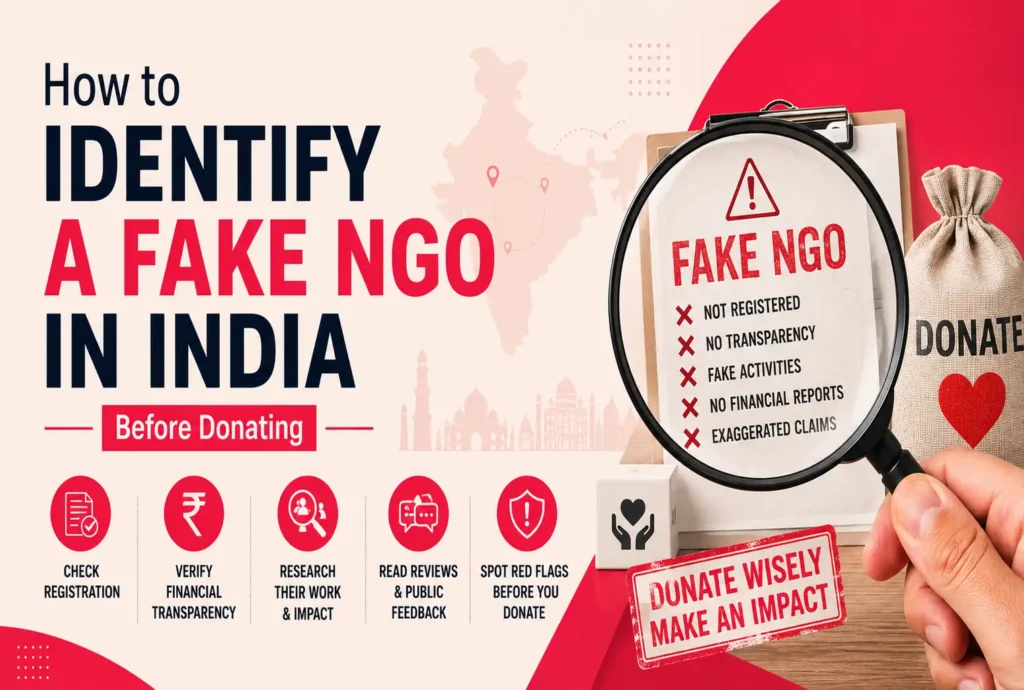
Key Insights
- Always ask for registration proof. A genuine NGO will never hesitate to share its registration number, PAN, and 12A/80G certificates.
- Personal bank accounts are a red flag. Donations should always go to an official organisational account, never a personal one.
- Urgency is a manipulation tactic. Real NGOs give you time to decide; fake ones rush you into donating before you can think it through.
- Bigger donations deserve deeper checks. For CSR funding or large personal donations, background verification services are worth the small cost.
- When in doubt, get it verified. A short verification check costs far less than losing money to a fraud that could have been avoided.
Every year, thousands of well-meaning people in India donate money to NGOs, thinking they’re helping a real cause. Sadly, not every organisation asking for donations is genuine. Fake NGOs have become a common problem, especially online, where a good-looking website and a sad story can convince anyone to open their wallet.
This guide will help you understand how to spot a fake NGO before you donate, so your money actually reaches the people who need it.
Why Fake NGOs Are a Growing Problem in India
India has lakhs of registered NGOs, but not all of them are working with honest intentions. Some are set up purely to collect donations that never reach any real cause. Others exaggerate their work or misuse funds meant for one purpose on something else entirely.
A few reasons this problem keeps growing:
- Setting up an NGO on paper is relatively easy and doesn’t always involve strict checks
- Emotional appeals (sick children, disaster victims, stray animals) get quick donations without questions
- Social media makes it easy to create a convincing presence without real work behind it
- Many donors never follow up to see where their money actually went
This doesn’t mean every NGO is fake. Most are doing genuine work. But it does mean donors need to be a little more careful before giving.
Common Warning Signs of a Fake NGO
Before you donate, watch out for these red flags.
1. No Registration Details Shared
Every legitimate NGO in India should be registered under one of these:
- Trust (under the Indian Trusts Act)
- Society (under the Societies Registration Act)
- Section 8 Company (under the Companies Act)
If an organisation can’t or won’t share its registration number, PAN, or 12A/80G certificate when asked, that’s a serious warning sign.
2. Pressure to Donate Immediately
Genuine NGOs are happy to answer questions and give you time to decide. Fake ones often push urgency: “the child needs surgery tomorrow” or “this offer ends tonight.” This pressure is designed to stop you from thinking too much or checking facts.
3. Vague or Missing Financial Reports
A real NGO usually publishes annual reports, audited financial statements, or at least a basic breakdown of how donations are used. If a website only shows photos and emotional stories with no numbers anywhere, be cautious.
4. Only Cash or Personal Bank Account Donations
This is one of the biggest red flags. Legitimate NGOs collect donations through an official organisational bank account, not a personal one. If someone asks you to transfer money to a personal UPI ID or a private account “on behalf of the NGO,” stop right there.
5. No Physical Address or Verifiable Office
A real NGO usually has an address you can look up, visit, or at least verify online. If the website has no address, or the address doesn’t match anything when you search it, that’s worth digging into further.
6. Copy-Pasted Content and Stock Photos
Some fake NGOs simply copy content, photos, and even success stories from real organisations. A quick reverse image search on their photos can reveal whether they’ve been used elsewhere.
Common Types of NGO Donation Scams
Fake NGOs don’t all work the same way. Knowing the common patterns makes it easier to spot one early.
The Door-to-Door Collector
Someone shows up at your home or office with a printed form, an ID card that looks official, and a story about a nearby orphanage or hospital. They collect cash on the spot and are never seen again. Real NGOs rarely rely on random door-to-door cash collection as their main funding method.
The Disaster Relief Fake
After floods, earthquakes, or other disasters, fake pages and accounts pop up within hours, using real news photos to collect “relief funds.” Genuine relief organisations usually take a little longer to set up donation drives, since they’re actually coordinating logistics on the ground.
The Fake Corporate Partner
Some scams target businesses directly, claiming a partnership with a well-known company or government scheme to appear more credible. A quick call to the company they claim to represent usually settles this in minutes.
The Social Media Sob Story
A single photo, a heartbreaking caption, and a QR code. These accounts often vanish and reappear under a new name once people start asking questions. If an NGO’s entire presence is one viral post with no supporting website or registration details, treat it with caution.
How to Verify an NGO Before Donating
Here’s a simple checklist you can follow before donating any amount, big or small.
Check the Registration
Ask for the NGO’s registration certificate and PAN. You can also check basic details through platforms like Darpan (NGO Darpan, run by NITI Aayog), which lists registered NGOs across India.
Ask for 12A and 80G Certificates
These certificates matter for two reasons. 12A confirms the NGO is registered as a non-profit, and 80G means your donation is eligible for tax deduction. If an NGO can’t show these, treat it as a warning sign, not a small detail.
Look for a Real Track Record
Search the NGO’s name along with words like “review,” “fraud,” or “complaint.” Genuine NGOs usually have some online presence beyond their own website: news mentions, partnerships, or social media activity that’s been active for years, not weeks.
Visit if Possible
If the NGO is local and the donation amount is significant, visiting their office or project site in person tells you more than any website ever could. Notice whether the address matches what’s listed online, whether the staff can answer basic questions about their work, and whether the place actually looks active rather than empty or under construction with no clear activity.
Talk to Past Donors or Volunteers
If you know anyone who has volunteered or donated before, ask them directly. Honest feedback from someone who has seen the work firsthand is hard to fake.
When You Need Deeper Verification
For small, one-time donations, basic checks are usually enough. But for larger donations, corporate CSR funding, or long-term partnerships, it’s worth going a step further.
This is where professional background verification services come in. A verification expert can check:
- Whether the NGO’s registration is active and genuine
- Whether the address and office actually exist
- Whether past complaints or legal issues are on record
- Whether the people running the NGO have a history of similar organisations shutting down suddenly
Businesses planning CSR contributions, in particular, should never skip this step. A wrong donation doesn’t just waste money, it can also create compliance issues for the company later.
How a Private Investigator Can Help
If something about an NGO doesn’t feel right, but you can’t confirm it on your own, a private investigator in Kolkata can look into it properly. This usually includes:
- Verifying the NGO’s registration and legal status
- Confirming the physical address through an on-ground visit
- Checking the background of founders and key people involved
- Reviewing how past donations have actually been used
- Identifying any pattern of similar NGOs being opened and shut down
This kind of check is especially useful before large donations, CSR partnerships, or when a family member wants to get seriously involved with an organisation they don’t know much about.
What To Do If You Suspect an NGO Is Fake
If you’ve already donated or suspect fraud, here’s what you can do:
- Report it to the local police cyber cell if the NGO operated online
- File a complaint with the Ministry of Corporate Affairs if it’s registered as a Section 8 company
- Check NGO Darpan to report inconsistencies in registration
- Warn others through reviews or social media, so fewer people fall for the same trick
Acting quickly doesn’t just protect you. It can stop others from losing money to the same fake organisation.
Final Thoughts
Donating to a good cause should feel meaningful, not risky. A little research before you give, checking registration details, financial transparency, and how donations are actually used, goes a long way in making sure your money reaches real people who need it.
If you’re unsure about an NGO and want a proper check before donating or partnering with them, Eye Witness can help verify the facts, so your generosity goes where it’s meant to.